Magnetic Resonance Imaging (MRI) is a procedure that is non-invasive and does not involve the use of any radiation. MRI uses a very strong magnet, radiofrequency pulses and a computer to produce detailed images of organs, tissues, bone, and other internal structures of your body. A radiologist interprets these images to aid in the diagnosis and treatment of various medical conditions.
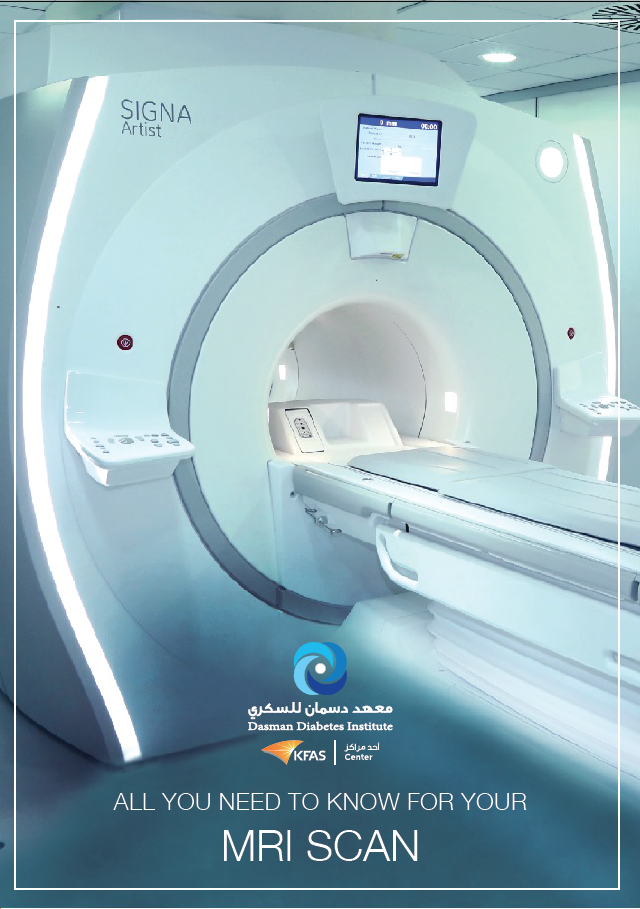
Diagnostic Imaging Center of Dasman Diabetes Institute houses two state-of-the-art machines (1.5 Tesla (SIGNA Artist) – wide-bore & 3 Tesla) for comfortable and precise imaging.
In case you are claustrophobic, please talk to your referring doctor prior to the appointment.
Note: Procedures under anesthesia are not performed at our Diagnostic Imaging Center.
Contraindications
As MRI involves a magnetic field, you will be asked metal safety questions at the time of your appointment. While many implants are compatible with the MRI machine, certain implants may not be allowed inside the scan room for safety reasons.
Some examples of such implants are listed below:
- Cardiac pacemakers: The technologist will check and decide as per its type.
- Prosthetic heart valve: The technologist will check and decide as per its type.
- Intracranial aneurysm clips
- Ferromagnetic implants e.g. in middle ear
- Metallic foreign body (insulin pump, intra-orbital implant, intra-osseous implant, bullets, shrapnel)
- Neurostimulators
- Metal particles or chips in your eye and retinal tacks
- Magnetically activated biomedical devices (such as a defibrillator, eye implant or ventricular peritoneal shunt)
- Free Style Libre Sensor (Flash glucose monitoring system): The technologist will check and decide as per its type.
In case you have any implants, it is helpful to have the make and model of the implant handy to make it easier to verify whether the implant is MR-safe. By informing the radiology personnel of any metal implants in advance, your safety can be ensured, and necessary modifications to procedures can be done.
In certain cases, a clearance from your doctor regarding the implants will be required to facilitate a smooth appointment.
What to bring on the day of your appointment
- MRI request form
- Civil ID
- Insurance card (if applicable)
- Any card, paper or information letter you have of any device or implant that you have in your body.
- Any previous reports, CDs, films, etc. of any prior relevant studies (such as X-rays, MRI scans, CT scans) you may have undergone, for comparison purposes.
Preparation
- Light meals such as fruit juices, biscuits, and toast is accepted for non-contrast studies.
- Please wear comfortable and loose clothes that do not have any metallic object (zipper, Clasps, or snaps).
Magnetic Resonance cholangiopancreatography (MRCP):
If you are having an MRCP study, you will need to fast for 4 hours prior to examination.
Contrast studies:
If your doctor has ordered an MRI exam with contrast, you will be required to fast for 4 hours. You can continue taking your routine medications on the day of the examination. However, you should not take any morning dose of insulin. You will also have to bring blood reports showing your kidney function tests (especially creatinine levels). The blood report must be within 4 weeks of your exam.
If there is a possibility of pregnancy, examinations will not be performed, and the appointment will be rescheduled until after pregnancy is ruled out.
On the day of the appointment
- Please arrive at the Diagnostic Imaging Reception at least 30 minutes before your test. Failing to attend within 20 minutes of the given appointment time may lead to cancellation.
- Parent or guardian of patients younger than 18 years of age must accompany the patient.
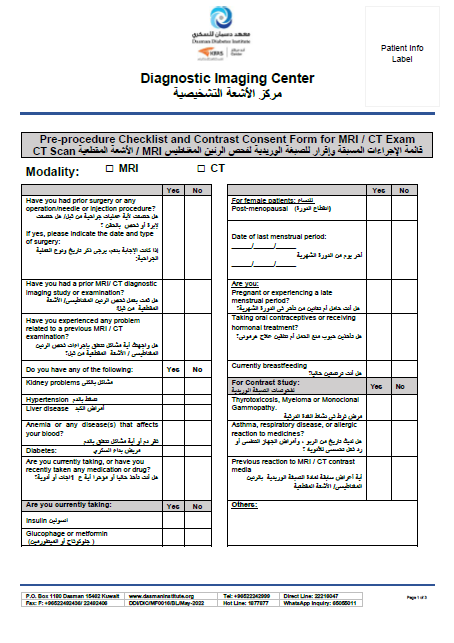
- Kindly inform the receptionist in case of any history of allergies, asthma, presence of any implants, surgeries involving any type of implants.
- For female, if there is any possibility of pregnancy, you may sign a pregnancy consent form before starting the MRI exam.
- Parent or guardian of patients younger than 18 years of age will sign pediatric consent form for MRI.
- You can continue taking your routine medications on the day of the examination unless you are instructed otherwise by the DIC reception staff.
- You will be asked to change into a gown before your exam.
- It is advisable that you leave all the valuables at home. The center bears no responsibility if lost.
- In case you have personal belongings, you can give them to your relative/ attendant for safety. Alternatively, you can use the locker inside the changing room.
- The following items should be removed prior to your examination:
- Hearing aid
- Dentures
- Watches, eyeglasses
- Hair wigs and hairpieces
- Bank magnetic cards
- Coins, keys, pens and jewelry
- Eye-makeup or mascara
- Mobile phone.
It is recommended not to use mascara, hair gel, or have wet hair as this can affect the magnet signal. Dental fillings, hip replacements, knee replacements, and contact lenses are acceptable.
- A metal safety questionnaire will be duly filled along with other necessary paperwork.
- Once cleared, you will enter the scan room under the supervision of an MRI technologist. Depending on the constraints of the examination you are undergoing, you will enter the machine on a sliding table head-first or feet-first. The body region of interest will be positioned at the center of the scanner. A special MRI detecting device may be placed on or around the part of your body being scanned to get better images. You will be able to communicate with the technologist via an intercom system.
- For certain examinations, you may be asked to hold your breath for a short time while acquiring different sequences. The machine makes loud humming or knocking noises while scanning to produce a picture of the area being examined. You will be given ear plugs or a headset to help minimize the noise.
- Generally, examinations take about 30 to 60 minutes to complete.
After your test
- Since there are no aftereffects with MRI, you may resume your normal activities immediately.
- Following contrast studies, you will be asked to stay for some time so that you can be monitored.
- Remember that if you have taken any medication for anxiety, you will need a ride home.
- Upon completion of your MRI exam, you may proceed to reception for information about the collection of your report.
Contact Us
For any inquiries, cancellations or for rescheduling your appointment, please contact us at: